How are ICE Fines Calculated? – ICE vs. OCAHO

[Editor’s Note: today’s post was written by guest blogger Bruce Buchanan, partner-in-charge of Immigration Practice, King & Ballow, LLP.]

A recent Office of Chief Administrative Hearing Officer (OCAHO) decision, U.S. v. Alyn Industries d/b/a Electronic Source Company, 10 OCAHO No. 1141 (2011), demonstrates continuing evidence of differences between Immigration & Customs Enforcement (ICE) and OCAHO in the calculation of fines from ICE audits.

In Alyn Industries, the company disputed ICE’s calculation of fines due. The company conceded it violated the Immigration Reform and Control Act of 1986 by: (1) hiring two employees without preparing an I-9 form; (2) hiring 59 employees without properly completing Section 2 of the I-9 form; and (3) hiring one employee without ensuring the employee properly completed Section 1 of the I-9 form.

ICE sought a total of $63,767 for the 62 violations. ICE calculated the fine by determining 100% of the I-9s contained substantive errors. Thus, under ICE’s Guide to Civil Monetary Penalties, Alyn was assessed the highest amount for a first offense – $935 per violation. The Guide has the following sliding scale:


Percentage of Substantive Violations            Fine

0 – 9%                                                                                       $110
10 -19%                                                                                   $275
20 – 29%                                                                                 $440
30 – 39%                                                                                 $605
40 – 49%                                                                                 $770
50% and Over                                                                       $935

[Editor’s note: for more details on fines, see ICE’s Form I-9 Inspection Overview.]

Additionally, there are five aggravating or mitigating factors, each worth 5%. The five factors are: size of business, good faith, seriousness of violations, whether any employees were unauthorized, and history of previous violations.

ICE determined 10% should be added to $935 due to the company’s lack of good faith and seriousness of the violations. Thus, $935 + 10% = $1,028.50 x 62 violations = $63,767. Alyn challenged ICE’s determination of aggravating and mitigating factors, asserting it was a small business that acted in good faith and had no previous violations. Thus, it asserted the fine per violation should be reduced by 15%.

Alyn asserted it was a small business because it employed 62 employees in July 2009, the time of the I-9 audit, and was down to 50 employees in December 2010. Moreover, it had a net loss of about $271,000 in 2010 and net income of only about $78,000 in 2009. ICE argued Alyn was a moderate sized business, which should not be the basis of an aggravating or mitigating factor.

OCAHO found Alyn was a small business since prior case law defined companies with less than 100 employees to be a small business. However, OCAHO declined to use the size as a mitigating factor, because it was not a “failing ‘mom and pop’ operation.”

ICE argued Alyn’s tenure as a business for over 10 years with revenue in the millions demonstrated it should have been able to train its management on verifying employment eligibility and its 100% failure rate showed its lack of good faith. Alyn asserted the errors were based on carelessness and after the I-9 audit, it enrolled in E-Verify and “instituted stringent compliance checks.” OCAHO was not persuaded by either party that good faith or lack thereof was an aggravating or mitigating factor.

Concerning the seriousness of the violations, OCAHO found all but two of the 62 violations were serious. However, OCAHO declined to use such as an aggravating factor.

Alyn argued because it did not have a history of previous violations, it should receive a mitigating factor. OCAHO found “never having violated the law does not necessarily warrant” leniency. Thus, this factor did not change the amount of the fine.

Despite not finding Alyn should receive any reduction in the amount of fines due to any mitigating factors, OCAHO concluded… [A]s a matter of discretion, a penalty nearer the mid-range are found more appropriate… and the penalties are accordingly set at $700 each for the 60 most serious violations and $500 each for the other two violations, for a total penalty of $43,000.

Although OCAHO denied this was a similar case to U.S. v. Snack Attack Deli (Subway), 10 OCAHO No. 1137 (2010), where OCAHO determined the company could not afford the fine sought by ICE, the result is eerily similar. In Snack Attack, OCAHO lowered the fines from $110,000 to $27,150 without any reasoned analysis.

The Alyn decision demonstrates OCAHO will continue to assert its discretion in determining the penalties and will not feel bound by ICE’s Guide in this determination.


Disclaimer: The content of this post does not constitute direct legal advice and is designed for informational purposes only. Information provided through this website should never replace the need for involving informed counsel on your employment and immigration issues.


Discover how Tracker’s electronic I-9 software service lets you produce flawless I-9s every time. Feel free to contact us we’d love to hear from you.
ICE is Back with More Inspections. What Does This Mean?

[Editor’s Note: today’s post is brought to you by guest blogger Bruce Buchanan, partner-in-charge of Immigration Practice, King & Ballow, LLP.]

The U.S. Immigration and Customs Enforcement (ICE) issued Notices of Inspection (NOIs) to a number of employers on November 4, 2011. ICE will not release the number of NOIs, though it is believed to be about 500, or the names and locations of the businesses served with NOIs.

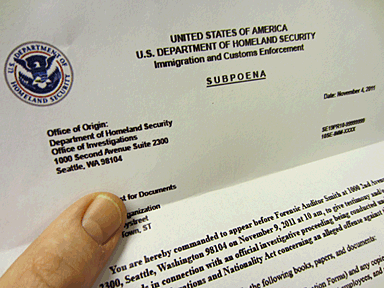
ICE Subpoena, Notice of Inspection (NOI)If your business was not targeted, count yourself lucky. If your business is served with a NOI, what should you do and what will happen during the inspection/investigation? Having represented clients in several ICE audits in past few years, here are my thoughts and insights.

The NOI, which begins the ICE audit, is hand-delivered by an ICE agent of Homeland Security Inspections (HSI) to the business with a demand to inspect the I-9 records plus other employment-related records, such as payroll records, Social Security no-match letters, and a list of related companies. An employer has three days to comply with the NOI and should never provide the requested records upon initial receipt of the NOI. Sometimes ICE is willing to provide more than three days, if requested. An employer should contact their immigration counsel immediately upon being served with a NOI.

During the period between the delivery of the NOI and the deadline to provide the I-9s and other records, the employer and immigration counsel have the opportunity to determine if all of the employees’ I-9s are in order and, if not, make any necessary corrections/additions plus determine whether all employees have proper work authorization. During these three days, the employer’s HR manager (or whoever is in charge of immigration compliance for the employer) and immigration counsel will be spending a lot of time together. You should delegate the gathering of non-I-9 related records to another management official besides the one in charge of I-9s.

ICE will then return to the employer’s facility and remove the I-9s and related records or the employer and counsel must hand-deliver them to the local ICE office. (Employers should always make copies of the I-9s before providing ICE with the original I-9s.) At this point, the I-9s are sent to an ICE auditor.

Following the audit, which may take 2 to 18 months, ICE will provide a Notice of Suspect Documents, if applicable. This notice lists the names of all employees who could not be authenticated as having valid work authorization. At this point, the employer must give notice, in writing or verbal, to each affected employee and provide him or her with an opportunity to correct any mistakes, provide proper work authorization documents, or assert ICE made a mistake. The employer then provides such documents or assertions to ICE for their review. If an affected employee does not comply, the employer should terminate the employee.

Moreover, if the employer terminates the affected employees after providing notice and an opportunity to provide new documentation, an employer will not be subject to any fines or penalties for knowingly employing unauthorized workers – unless ICE discovers other evidence that the employer was aware of the affected employee’s illegal status. The fact that the employer hired an illegal alien, who provided a false A number, permanent resident card, work authorization document or Social Security number, is insufficient to prove the employer knowingly hired any illegal aliens.

Thereafter, ICE will provide the employer with a Notice of Technical or Procedural Failures and the underlying I-9s that have such errors. The employer has 10 days to correct the technical errors. If they are correctable and corrected, ICE will not issue any fines for these violations.

The final step in the audit is a “Notice of Intent to Fine” for substantive and uncorrected technical violations and/or for “knowingly employing” illegal aliens. Additionally, “knowingly employing” illegal aliens’ charges carry possible criminal indictments. An employer has 30 days to agree to pay the fines, reach a resolution on the amount of the fines or challenge the determination before the Office of Chief Administrative Hearing Officer (OCAHO).

Before ICE comes knocking at your door, your business should develop an immigration compliance program, which includes a self-audit of your I-9s, training for applicable management, draft and implement immigration compliance policies, including whether to use E-Verify.

Disclaimer: The content of this post does not constitute direct legal advice and is designed for informational purposes only. Information provided through this website should never replace the need for involving informed counsel on your employment and immigration issues.

To learn more about how I-9 Compliance Software can help you comply with Form I-9 and E-Verify requirements, click here.

ICE Issues New Round of Notices of Inspection to Employers

“U.S. Immigration and Customs Enforcement (ICE) issued Notices of Inspection (NOIs) to various employers on Friday, Nov. 4. These inspections are designed to determine whether or not the businesses are violating U.S. employment laws by hiring unauthorized workers. The names and locations of the businesses will not be released at this time due to the ongoing nature of the inspections,” according to a statement released by the ICE public affairs department today.

So how can you best prepare for a potential ICE audit?

First, companies should consider conducting a preemptive internal audit to get your I-9 house in order. Then analyze your results, initiate targeted training, and standardize your I-9 practices and procedures.

As you will probably find out, the paper Form I-9 process is error-prone and hard to centralize. Therefore, after conducting the internal audit you will want to implement a trustworthy electronic management system to keep track of all the I-9 documents, deadlines, and work visa reverification requirements.

These steps are especially important for companies that have a large number of employees, high turnover rates, and/or multiple worksites. Of course, employers should always consider the need for involving informed counsel on your employment and immigration issues.

Disclaimer: The content of this post does not constitute direct legal advice and is designed for informational purposes only. Information provided through this website should never replace the need for involving informed counsel on your employment and immigration issues.


To learn more about how I-9 Compliance Software can help you comply with Form I-9 and E-Verify requirements, click here.

Several major US employers join IMAGE compliance program

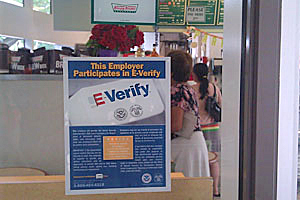
E-Verify compliance notice at IMAGE employerOn November 4, U.S. Immigration and Customs Enforcement (ICE) announced that seven major employers in the U.S. joined IMAGE, the agency’s voluntary employment compliance program. These newly joined employers include Best Western International, Chick-fil-A, Inc., Hyatt, Kelly Services, Lexmark, Smoothie King and Toyota Motor Engineering and Manufacturing North America.

Here is a complete list of IMAGE partners.

IMAGE stands for “ICE Mutual Agreement between Government and Employers,” created to promote voluntary compliance and help companies ensure they are maintaining a lawful workforce.

To participate in IMAGE, companies volunteer to enroll in E-Verify, to follow written hiring policies that enforce I-9 compliance, and to engage in annual self-audits.  Furthermore, IMAGE companies agree to submit to an ICE audit of their I-9 employment eligibility forms. In return, ICE agrees to:

  • Waive potential fines if substantive violations are discovered on fewer than 50 percent of the required Forms I-9.
  • In instances where more than 50 percent of the Forms I-9 contain substantive violations, ICE will mitigate fines or issue fines at the statutory minimum of $110 per violation.
  • ICE will not conduct another Form I-9 inspection of the company for a two-year period.
  • ICE will provide information and training before, during and after inspection.

According to the ICE website, the idea behind the IMAGE program is for employers “to place an emphasis on self-policing in a company’s hiring practices. By following the prescribed steps of IMAGE, a company could lessen the likelihood of being found in violation of employment laws. IMAGE participation may be considered a mitigating factor in the determination of civil penalty (fine) amounts should they be levied. In addition, IMAGE membership can enhance your corporate image by associating your company with sound hiring practices, and helps to secure the homeland by reducing opportunities to inadvertently hire unauthorized workers.”

Clearly, participating in the IMAGE program is a significant commitment that carries real ongoing costs (annual internal audits, training) and potential costs (Form I-9 fines). While ICE has made an effort to “soften” the risk of being fined based on the Form I-9 inspection result, the fact that IMAGE is not offered as a safe harbor is one of the primary reasons employers are reluctant to participate in the program. For all of these reason, employers should consult with legal counsel before making a decision to enroll.

In light of some of the most recent ICE worksite enforcement statistics announced in October (see below), now more than ever employers should  consider strengthening their corporate employment eligibility verification compliance program.

In FY 2011, ICE:

  • Conducted 2,496 I-9 audits, up from 503 in FY 2008
  • Initiated 3,291 worksite enforcement cases, up from 1,191 in FY 2008
  • Criminally arrested 221 employers, up from 135 in FY 2008
  • Issued 385 Final Orders for $10,463,987 in fines, up from 18 Final Orders for $675,209 in fines in FY 2008
  • Debarred 115 individuals and 97 businesses, compared to zero debarments in FY 2008

For more information on the IMAGE program, please visit: http://www.ice.gov/image/faqs.htm.

Disclaimer: The content of this post does not constitute direct legal advice and is designed for informational purposes only. Information provided through this website should never replace the need for involving informed counsel on your employment and immigration issues.

To learn more about how I-9 Compliance Software can help you comply with Form I-9 and E-Verify requirements, click here.

California Outlaws Local E-Verify Laws (AB 1236)

[Editor’s Note: today’s post is brought to you by guest blogger John Manley, U.S. Immigration Attorney and Co-Liaison to U.S. Customs and Border Patrol.]

Taps for E-Verify in CA?

On October 9, 2011, Governor Jerry Brown signed into law A.B. 1236. A.B. 1236 prohibits local governments from making E-Verify mandatory for employers within their borders.

Here is the full text of the bill: A.B. 1236

As part of the bill, the Legislature made a number of interesting findings:

1) A 2007 independent evaluation commissioned by the federal Department of Homeland Security found that the electronic employment verification database was still not sufficiently up to date to meet requirements for accurate verification. This has led to employers being unable to hire employees in a timely manner and kept workers from earning wages.

2) Mandatory use of an electronic employment verification program would increase the costs of doing business in a difficult economic climate. The United States Chamber of Commerce estimates that the net societal cost of all federal contractors using the E-Verify Program would amount to $10 billion a year, federally.

(3) California businesses would face considerable odds in implementing such a program. Employers using the program report that staff must receive additional training that disrupts normal business operations. If E-Verify had been made mandatory for all [California] employers in 2010, it would have cost businesses $2.7 billion, $2.6 billion of which would have been borne by the small businesses, which drive our economy.

Cities such as Temecula, Lancaster, Murrieta, and Lake Elsinore did have existing E-Verify ordinances requiring private employers to use E-Verify. After A.B. 1236, these ordinances are now null and void.

Under A.B. 1236, therefore,except as required by federal law, or as a condition of receiving federal funds, neither the state nor a city, county, city and county, or special district shall require an employer to use an electronic employment verification system, including under the following circumstances:

(a) As a condition of receiving a government contract.

(b) As a condition of applying for or maintaining a business license.

(c) As a penalty for violating licensing or other similar laws.

“Employer” means an employer other than the state, or a city, county, city and county, or special district. Local government entities may still require other government entities to use E-Verify under A.B. 1236, and as required by federal law, or as a condition of receiving federal funds.

Disclaimer: The content of this post does not constitute direct legal advice and is designed for informational purposes only. Information provided through this website should never replace the need for involving informed counsel on your employment and immigration issues.

To learn more about how I-9 Compliance Software can help you comply with Form I-9 and E-Verify requirements, click here.