ICE issues 180 I-9 Audit Notices to Employers in 5 States

Today, the U.S. Immigration and Customs Enforcement (ICE) issued its latest round of I-9 Notices of Inspection (NOIs) to 180 businesses in the Southeast, including Louisiana, Mississippi, Alabama, Arkansas and Tennessee. As previously reported, these audits stem from a new government strategy implemented in 2009 to reduce the demand for unauthorized employment and protect employment opportunities in the US. Under this strategy, ICE has been focusing its resources on administrative actions (such as I-9 auditing) rather than using the high profile (and more expensive) ICE raid as done in years past.

I-9 Auditing Links

Over the past year, we published several articles on the I-9 audit process, including potential fines. For your convenience, here are links to these various resources.

New Look of E-Verify Revealed

The DHS began testing its redesigned E-Verify interface, which includes new navigation tools, case alert functionality, and other features designed to increase employer compliance while maintaining employee privacy. The new E-Verify look is part of a broader DHS initiative to improve operating efficiency and user friendliness in response to previous evaluations which found the system to be burdensome and lacking in safeguards. While employers will most likely welcome the new look and functionality, these cosmetic changes won’t address the program’s effectiveness or accuracy rate, which came under fire last week. DHS seems committed, however, to continually improve the system on both fronts, so let’s take a sneak peak at some of the pros and cons of this redesigned interface.
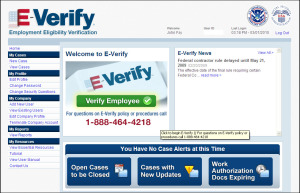
HomePageThe Home Page has been redesigned to provide a quick link to start a new verification and also inform users of E-Verify news and case alerts. At present, the news appears to be more along the lines of system alerts, which in the past, have not been updated that frequently. The navigation pane on the left-hand side has also been modified, although the overall functionality is the same.

E-Verify Case Alerts are located at the bottom of the screen, and are intended to bring to your attention cases that need some action. In particular, users can see Open Cases to be Closed; Cases with New Updates; and Work Authorization Documents Expiring. This last alert, while helpful on the surface, may actually cause confusion since employers are supposed to reverify employment authorization on the I-9 form in these situations, and not through E-Verify.
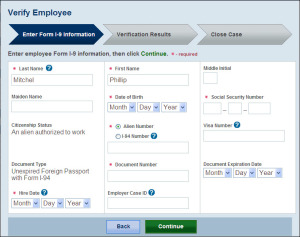
VerifyEmployeeVerification: the screen for entering I-9 information now displays the fields in 3 columns (rather than 1 long one) and features pull-down menus for the various date fields (hire date, doc expiration date, etc.). The SSN field now has 3 boxes to force the user to enter the number in a proper format. After the verification has been completed, the system will mask the SSN, to preserve the employee’s privacy. Noticeably absent, however, is real-time field alerts when the user has entered an improper document number or hire date.

Navigation and instructions As you’re performing an E-Verify query, the system highlights a progress indicator (>>) to visually represent where you are in the verification process. E-Verify Instructions and terms have also been simplified (e.g., “resolve case” will now be called “close case”).
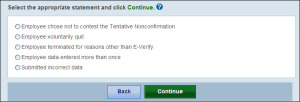
closecaseClose case process has also been reworked so the employer now has choices written in plain language. (Say good bye to “Invalid Query!”).  The first question asked is whether the employee is currently employed with the company. If yes, the user can choose to indicate that they entered data more than once, submitted incorrect data, or the employee chose not to contest a TNC (if applicable). If the employee is not currently employed, the employer can indicate whether the employee quit or was terminated for some other reason.

It’s not yet clear when E-Verify will release this new look on their live servers, but given the recent pressure and scrutiny, I expect to see it very soon.

DHS to publicly display information on Federal Contractors using E-Verify

The Department of Homeland Security (DHS) has announced its intent to publicly display information on businesses using E-Verify on searchable areas of its web site.  According to the DHS, the release of this information is allowed under the terms noted in the Memorandum of Understanding (MOU), which must be executed by all employers enrolling in the E-Verify program. A careful reading of the MOU reveals that an employer must agree that E-Verify is not confidential information and may be disclosed as authorized or required by law and DHS or SSA policy, including but not limited to, Congressional oversight, E-Verify publicity and media inquiries, determinations of compliance with Federal contractual requirements, and responses to inquiries under the Freedom of Information Act (FOIA). Presumably, the disclosure of this information on the DHS web site falls under the very wide scope of “DHS policy.”   

In particular, DHS may post an employer’s registered business name, contact address, workforce size, employee verification option (all new hires or entire workforce), and overall E-Verify volume (number of queries). Now more than ever, employers registering as federal contractors should be vigilant in following all of the E-Verify rules, especially since their hiring activity and other information may now be subject to increased public scrutiny.

This E-Verify announcement is currently available on the E-Verify home page as well as the alert section of employers’ E-Verify dashboard.

Cincinnati Poultry Company Pays $536,046 fine for I-9 violations

In a press release issued yesterday, ICE reported that Koch Foods of Cincinnati LLC paid a $536,046 fine as a result of a worksite enforcement investigation conducted by ICE in 2007. The investigation led to a raid of Koch’s Fairfield, Ohio, processing facility and the arrest of 161 undocumented workers in August 2007. ICE also executed a search warrant at Koch’s corporate offices in Chicago seizing relevant documents.

It’s important to note that the half a million dollar fine relates specifically to Form I-9 violations, which is consistent with ICE’s new approach to worksite enforcement. ICE issued the Notice of Intent to Fine on February 8, and the fine was paid on February 9 in Cleveland. Since the investigation, Koch Foods has apparently implemented new hiring procedures and an immigration compliance program to prevent future violations. The company is now also using E-Verify.

In announcing this fine, ICE reminded employers that they have implemented a new, comprehensive strategy to reduce the demand for unauthorized employment by focusing their resources on auditing and investigating employers who are suspected of cultivating and hiring undocumented workers. In addition, ICE has also been increasing the number of random Form I-9 audits on all employers, regardless of size or industry.

State and local E-Verify changes arriving with the New Year

On January 1, 2010, new state and local E-Verify requirements will go into effect in Georgia, South Carolina, Illinois, and Lancaster, California.  Here is a quick summary for all employers doing business in these locations :

South Carolina: presently, the South Carolina Illegal Immigration Reform Act requires all employers with 100 employees or more to participate in E-Verify or only hire employees who possess or qualify for a South Carolina driver’s license (or other state license with similarly strict requirements). Starting in the New Year, the law will expand to include all state contractors, regardless of size. By mid-year (July 1), it will cover all employers.

Illinois: as of January 1, 2010, employers choosing to voluntarily enroll in E-Verify are urged to consult the Illinois Department of Labor website, which will contain information regarding the accuracy of E-Verify, the financial burden on employers, and their responsibilities. In addition, employers enrolling in E-Verify must complete an attestation form to indicate that the employer (a) has received E-Verify training materials and that all employees who will administer the program have completed the tutorial; and (b) has posted the required participation and anti-discrimination notices. The new law also creates a cause of action for employees and prospective employees in the event the employer fails to abide by the various E-Verify provisions. The entire law can be viewed here.

Georgia: On January 1, 2010, public employers (city, municipality and county), contractors and subcontractors will be required to post their federally issued E-Verify user identification number and date of authorization to use E-Verify on their website. Covered cities that do not maintain a website must annually publish the identification number and date of authorization in the legal organ for the county. (*O.C.G.A. Section 13-10-91 requires that all public employers register and participate with E-verify). See this page for more information.

Lancaster, CA: Beginning January 1, 2010, businesses operating in the City of Lancaster (California) will be required to use E-Verify for all new hires. The ordinance also states that those who hire unauthorized workers may have their business licenses revoked. For more information, visit this site.