E-Verify Services Suspended Due to Government Shutdown

E-Verify Closed

As of the time of this post, the US Federal Government has yet to reach a budget agreement and a partial government shutdown is in effect.  Among the many Federal Agencies that are affected by the shutdown, the Department of Homeland Security will suspend E-Verify until funding is restored. Continue reading for more details.

Note that a federal government shutdown does NOT impact an employer’s I-9 responsibilities. Employers should continue to process I-9s as they normally would. Employer should also expect to create cases in E-Verify when E-Verify becomes available.

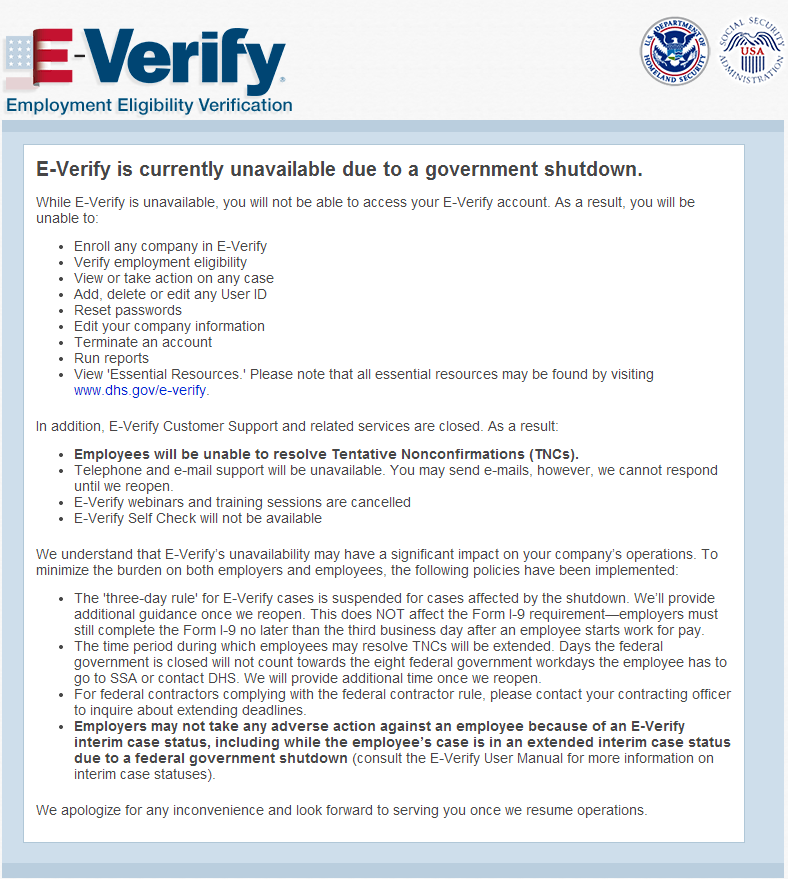
According to the E-Verify home page (here), as a result of the shutdown employer will be unable to:

  • Enroll any company in E-Verify
  • Verify employment eligibility
  • View or take action on any case
  • Add, delete or edit any User ID
  • Reset passwords
  • Edit your company information
  • Terminate an account
  • Run reports
  • View ‘Essential Resources.’ Please note that all essential resources may be found by visiting www.dhs.gov/e-verify.

In addition, E-Verify Customer Support and related services are closed. As a result:

  • Employees will be unable to resolve Tentative Nonconfirmations (TNCs).
  • Telephone and e-mail support will be unavailable. You may send e-mails, however, we cannot respond until we reopen.
  • E-Verify webinars and training sessions are cancelled
  • E-Verify Self Check will not be available

To minimize the burden on both employers and employees, E-Verify has implemented the following policies:

  • The ‘three-day rule’ for E-Verify cases is suspended for cases affected by the shutdown. E-Verify will provide additional guidance once normal operations are restored. This does NOT affect the Form I-9 requirement—employers must still complete the Form I-9 no later than the third business day after an employee starts work for pay.
  • The time period during which employees may resolve TNCs will be extended. Days the federal government is closed will not count towards the eight federal government workdays the employee has to go to SSA or contact DHS. E-Verify will provide additional time once E-Verify reopens.
  • For federal contractors complying with the federal contractor rule, please contact your contracting officer to inquire about extending deadlines.
  • Employers may not take any adverse action against an employee because of an E-Verify interim case status, including while the employee’s case is in an extended interim case status due to a federal government shutdown (consult the E-Verify User Manual for more information on interim case statuses).

When E-Verify service resumes, employers will need to process the backlog of hires that would have otherwise been run through E-Verify but for the shutdown. If you still complete the Form I-9 on paper, here are some ideas for how to plan ahead and get through backlog:

  1. Keep a consolidated list of new employees who will need to be processed. Have their Form I-9s handy so you can churn through them quickly once E-Verify services resume.
  2. If the government shutdown lasts awhile, consider adding additional staff to help get through the backlog.
  3. Be prepared to answer questions, especially for those employees who are still in the process of contenting TNC, which they have been granted extra time to resolve.
  4. Carefully monitor the situation, and be prepared to resume E-Verify transactions as soon as you can after E-Verify service is restored.

If you process I-9’s electronically with a system like Tracker I-9 Complete with E-Verify, managing the E-Verify process during the shutdown is easy. Backlogged cases are seamlessly managed through automated processing and reminders.

Again, please note that a federal government shutdown does NOT impact an employer’s I-9 responsibilities. Employers should continue to process I-9s as they normally would.
Disclaimer: The content of this post does not constitute direct legal advice and is designed for informational purposes only. Information provided through this website should never replace the need for involving informed counsel on your employment and immigration issues.

Discover how Tracker’s electronic I-9 software service lets you produce flawless I-9s every time. Feel free to contact us we’d love to hear from you.


ICE Quietly Knocks on the Door: 1,000 New Audits

police

U.S. Immigration and Customs Enforcement (ICE) appears to have launched its latest crackdown on I-9 compliance. While no public announcement has been made, according to reports by attorneys and the Wall Street Journal, ICE inspectors have quietly knocked on the doors of about 1,000 businesses in the past few weeks, handing each a Notice of Inspection (NOI).

Over 3,000 audits last year

While over 3,000 businesses had ICE inspectors appear on their doorstep to present audit notices in 2012, it has been some time since ICE has served a large “wave” of notices like this, all in one fell swoop.

What to expect if they come knocking

As you may know, when you receive a NOI, you have 72 hours to collect the Form I-9s and other records ICE demands. An audit can include any sampling of your workforce, and often includes I-9 records for current employees as well as those terminated within a specified timeframe, across multiple work locations. ICE has broad authority in how it conducts audits, and in some cases has audited an initial set of I-9 records, then later expanded the audit to demand further records.

If you use paper I-9s, brace yourself for a paperwork fine of approximately $555 per record

Paper Form I-9

Here at Tracker we have pretty deep insight into the error rates of legacy I-9 records, since we have an automated I-9 remediation product, Tracker I-9 Resolve. Having processed about a million records so far, we know that on average, 75% of paper I-9s have at least one error.

Using the average error rate, the weighted average of each error type, and the cost of that error type, we’ve been able to calculate that on average, each paper I-9 has a potential liability of $555.

You should also be prepared to clear calendars and dedicate the next 72 hours to responding to the NOI. With paper I-9s, we estimate it takes the equivalent of 5-6 days of labor to prepare your package for each 1,000 records ICE audits. Unfortunately, the more records and work locations included in the audit, or the less tidy your filing system, the bigger the effort to round up all the paperwork that’s required.

What should you do to be prepared for an ICE audit notice?

If you use paper I-9s, you should consider these steps:

  • Audit a sample of your existing paper records. This will give you an idea of the compliance level of your historical records.
  • Screen a sample of the I-9s your organization creates with the next set of new hires. Since compliance can vary by individual and office, try to screen a sample from each work location. This will give you an idea of your current compliance rate for new hires, and will reveal your most critical training needs.

Based on what you learn from the steps above, you’ll want to initiate training, standardize your I-9 practices, conduct additional audits, and take steps to remediate those I-9 that are found to be out of compliance. Unless your process calls for someone to double-check each I-9 immediately after it is created (and also each reverification), what you will likely discover is your error rate on both historical records and newly-created records is pretty close to the 75% cross-industry average.

With paper I-9s, the only way to improve your compliance levels is to increase the amount of time you put into I-9 processing, including screening and correcting each new I-9 as it is created. Tracker’s I-9 & E-Verify Calculator shows that in order to achieve high compliance with paper I-9s, an organization has to devote 107 minutes of labor for every new employee it hires. For many organizations, devoting this level of resources is simply not feasible.

So, once you determine your actual compliance levels, you might ask how important it is to increase those compliance levels. If it’s important, you can solve the problem by increasing your manual efforts or implementing an electronic I-9 system. You want to ensure that the system you select provides complete compliance for all new hires, and allows you to easily remediate your existing records without specialists or excessive labor. For guidance on the key capabilities to look for, read our free whitepaper: 5 Most Critical Requirements for I-9 Automation.

Disclaimer: The content of this post does not constitute direct legal advice and is designed for informational purposes only. Information provided through this website should never replace the need for involving informed counsel on your employment and immigration issues.

Discover how Tracker’s electronic I-9 software service lets you produce flawless I-9s every time. Feel free to contact us we’d love to hear from you.

Overview of New Form I-9 for Employers

[Editor’s Note: today’s post is brought to you by guest blogger Katie Nokes Minervino, Associate Attorney in the Immigration Group at Pierce Atwood LLP. Katie assists employers and employees in employment authorization needs and provides clients with support and guidance on employment verification requirements, best practices, and audit response.]

A new version of Form I-9 was released by USCIS on March 8, 2013. Employers were required by law to begin using the new version of Form I-9 effective immediately, but USCIS gave employers a 60-day grace period to implement the new form into business practice. This 60-day grace period ended on May 7, 2013. Employers must use the new version of Form I-9 for any new hires or I-9 re-verifications completed on or after May 7, 2013.

Federal law requires that every employer hiring an individual for employment in the United States must complete a Form I-9, Employment Eligibility Verification. As previously reported, the new version of Form I-9 includes new fields for employee telephone numbers and e-mail addresses. The new version has also been reformatted and is now two pages in length. The new version of Form I-9 is available at uscis.gov.

Check out an essential, interactive introduction to the new Form I-9 that identifies the changes and provides instructions. Click on the arrows at the bottom of the presentation screen to advance.

For updates regarding employment authorization and immigration, you can also follow Katie Minervino on Twitter @kminervino as she closely tracks E-Verify and other immigration-related developments.

Disclaimer: The content of this post does not constitute direct legal advice and is designed for informational purposes only. Information provided through this website should never replace the need for involving informed counsel on your employment and immigration issues.

Discover how Tracker’s electronic I-9 software service lets you produce flawless I-9s every time. Feel free to contact us we’d love to hear from you.

NEW Form I-9 Released

ICE Warning Notice
USCIS has published the long awaited release of a new Employment Eligibility Verification, Form I-9 ‘(Rev. 03/08/13)N’. Since it’s been over three and a half years since USCIS last released a new version of the Form I-9, this post seeks to help you understand what you can expect to see on the new Form I-9 and to help you start thinking about how it might impact your hiring and on-boarding process.

By way of background, nearly a year ago, USCIS  published the first draft of the new form. Then in August, USCIS proposed a few updates to the draft after reviewing over 6000 public comments. As a quick overview, here are the key changes you can expect to see on the new form:

    • New data fields, including the employee’s foreign passport information, phone number and email address;
    • Expanded form instructions; and
    • Revised form layout, increasing the paper form from one to two pages.

The new edition of the Form I-9 will take effect immediately on publication. However, employers can continue to use the previous versions of the Form I-9 (Rev. 08/07/09 and Rev. 02/02/09) for 60 days after the new Form I-9 is released. This means you must start using the form no later than May 7, 2013.

If you’re an employer, the change that will impact you the most will be the new fields. You’ll have to train hiring managers to understand the significance of the new fields, and apply compliance rules that ensure your forms continue to be filled out properly. Yes, the new fields do mean that the U.S. government has made the most complicated one-page form in the universe even more complicated!

Employers who process their I-9s manually typically rely on the USCIS instructions as their sole source of guidance. If this is your situation then it is critical for you to read and understand the expanded instructions released with this new form

Given that the new Form I-9 will impact the hiring process, the more you hire, the more you will be affected. Many companies are thinking about taking this opportunity to go electronic.  Since you are required to integrate a new Form I-9 into your business process, why not examine how an electronic I-9 solution can do most of the implementation work for you while dramatically improving both compliance and efficiency?  If you are ready or willing to switch to an automated I-9 system, make sure the system you adopt is poised to implement the new Form I-9 and meets or exceeds electronic Form I-9 requirements, such as Tracker I-9 Complete.

USCIS has updated their I-9 Central website with new instructions tailored to the new version of the Form I-9. From the I-9 Central website, you can also view or download the new Handbook for Employer, M-274, which has been revised and updated in light of the new Form I-9.

You can access the Department of Homeland Security’s notice published in the Federal Register informing employers of the new Form I-9 here.

Disclaimer: The content of this post does not constitute direct legal advice and is designed for informational purposes only. Information provided through this website should never replace the need for involving informed counsel on your employment and immigration issues.

Discover how Tracker’s electronic I-9 software service lets you produce flawless I-9s every time. Feel free to contact us we’d love to hear from you.

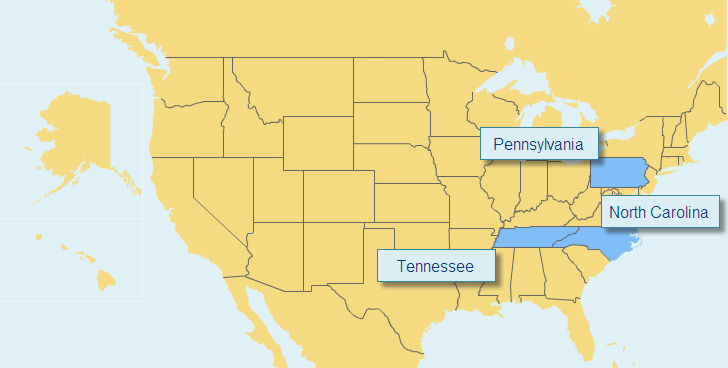
E-Verify Laws Take Effect on January 1, 2013 for 3 States

Laws mandating E-Verify use kicked in for some businesses in several states on Jan 1, 2013. Here is a quick synopsis of those impacted as of Jan 1, 2103:

North Carolina

Private employers in North Carolina with 100 or more employees must now confirm the work authorization of each new employee through E-Verify as per House Bill 36 (Session Law 2011-263). The law does not apply to seasonal temporary employees who are employed for 90 or fewer days during a 12-consecutive-month period.

Penalties: Failure to comply can result in civil fines ($10,000+) and notification to U.S. Immigration and Customs Enforcement and local law enforcement agencies.

Pennsylvania

Public works contractors and subcontractors in Pennsylvania must now use E-Verify to confirm employment eligibility of each new employee, as per Senate Bill 627 (Act 127), the Public Works Employment Verification Act.

Penalties: First violations incur a warning letter detailing the violation, posted on the website of The Department of General Services of the Commonwealth. On a second violation, the contractor is debarred from public work for 30 days. On subsequent violations, the contractor is debarred from public work for 180-365 days. In the case of a willful violation, the contractor is debarred from public work for a period of three years. Contractors will also incur a penalty of $250-$1,000 per violation.

Tennessee

Tennessee employers with more than 5 employees must now use E-Verify to confirm the work eligibility of new employees, or maintain a copy of a specified identity document, as per the Tennessee Lawful Employment Act, Public Chapter 436 (HB 1378).

Penalties: Employers can incur penalties of $500 plus an additional $500 for each employee not verified for a first violation; $1,000 plus an additional $1,000 for each employee not verified for a second violation; and $2,500 plus an additional $2,500 for each employee not verified for subsequent violations.

Disclaimer: The content of this post does not constitute direct legal advice and is designed for informational purposes only. Information provided through this website should never replace the need for involving informed counsel on your employment and immigration issues.

Discover how Tracker’s electronic I-9 software service lets you produce flawless I-9s every time. Feel free to contact us we’d love to hear from you.