Best Practice Tips to Avoid E-Verify’s Less-Obvious Pitfalls

[Editor’s Note: today’s post is brought to you by guest blogger Katie Nokes Minervino, Associate Attorney in the Immigration Group at Pierce Atwood LLP. Katie assists employers and employees in employment authorization needs and provides clients with support and guidance on employment verification requirements, best practices, and audit response.]

So you’ve taken the plunge and enrolled in E-Verify. Here are best practice tips to avoid the less-obvious pitfalls of E-Verify use.

[easyrotator]erc_33_1350586308[/easyrotator]


Disclaimer: The content of this post does not constitute direct legal advice and is designed for informational purposes only. Information provided through this website should never replace the need for involving informed counsel on your employment and immigration issues.

Discover how Tracker’s electronic I-9 software service lets you produce flawless I-9s every time. Feel free to contact us we’d love to hear from you.

USCIS Publishes Second Draft of New, Proposed Form I-9 for Review and Comment

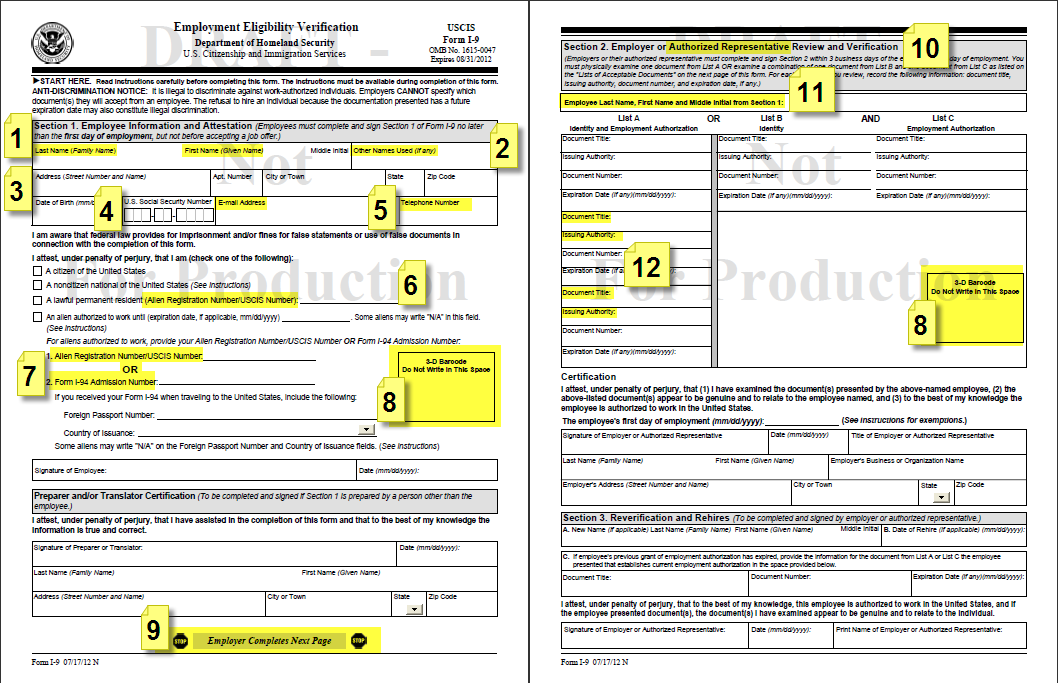
The NEW Proposed Two-Page Form I-9 with highlighted changes (see table of changes below). Click to enlarge.

As previously reported, on March 27, 2012, USCIS revealed an initial draft of a new Form I-9 for public review and comment. This first version was remarkably different than the current from. In addition to several new fields and an updated layout, most notably the form doubled in size going from one to two pages.

Reportedly, USCIS received of over 6,200 comments and suggestions on the initial draft, and recently USCIS published an updated version of the new Form I-9 with instructions that includes several changes to the first draft published back in May (see below). You can find more information about the newly proposed revisions to the Form I-9 here.

The new proposed Form I-9 is not yet effective, and employers should continue to use the current Form I-9, with a revision date of 08/07/09, until further notice.

USCIS welcomes your feedback on the new proposed two-page Form I-9. All comments should be submitted no later than  September 21, 2012 in order to ensure that they will be considered.

There are several ways to submit your public comments.

  • Submit your comment online at www.regulations.gov. Remember to indicate the e-Docket ID number “USCIS-2006-0068” in your comments.
  • Send an Email to uscisfrcomment@dhs.gov. Remember to include  “OMB Control Number 1615-0047” in the email subject line.
  • Mail your comment to the address below. Please be sure to indicate “e-Docket ID USCIS-2006-0068.”

DHS, USCIS, Office of Policy and Strategy
Laura Dawkins, Chief, Regulatory Coordination Division
20 Massachusetts Avenue NW
Washington DC 20529

PROPOSED CHANGES TO FORM I-9

Section 1

1. Last and First Name Fields: The form now shows “Last Name (Family Name)” and “First Name (Given Name)”, rather than the reverse.

2. Maiden Name is now called “Other Names Used (if any)”. Per the instructions, “Provide all other names used, if any (including your maiden name).  Write N/A if you’ve not had other legal names.

3. Address – Must be a US address, except for border commuters from Canada and Mexico.

4. The Social Security Number boxes are now formatted to fit the requisite 9 digits.

5. Email Address and Telephone Number – New fields.  Optional, per the instructions, but not marked as such on the form.

6. A-Number vs. USCIS Number: The instructions note that the “USCIS number is the same as the A-number without the “A” prefix. Another clarification: Foreigners authorized to work can provide either the A-Number/USCIS Number OR the Form I-94 number.

7. Form I-94 Admission Number: find the admission number on Form I-94 or “as directed by U.S. Customs and Border Protection in connection with your arrival in the United States.”  – leaving room for future procedural changes.

8. Barcode: – A space for a 3-D Barcode has been added to page 1 and 2, along with   “Do not write in this space.” As of the time of this post, the purpose of the barcode is unknown.

9. The form now has two “Stop Sign” icons at the bottom of page 1, instead of “Go to Next page.”  This is to prevent employees from accidentally completing section 2.


Section 2

10. Includes words to make it clearer that an “Authorized Representative,” such as designated agent or notary, can act in an agent capacity in completing Section 2.

11. Moved the employee name fields (Last, First, and Middle initial) underneath the Section 2 heading and added the words “from Section 1” indicating that it is acceptable for the employer to enter this data.

12 Added new fields for the document title and issuing authority of second and third list A documents which often pertain to foreign employees with certain document types.


Section 3 and List of Acceptable Documents

Minor changes only, mostly related to formatting and clarification of the “Social Security Account Number card” restrictions.


Disclaimer: The content of this post does not constitute direct legal advice and is designed for informational purposes only. Information provided through this website should never replace the need for involving informed counsel on your employment and immigration issues.

Discover how Tracker’s electronic I-9 software service lets you produce flawless I-9s every time. Feel free to contact us we’d love to hear from you.

DOJ Settles Claims of I-9 Documentation Discrimination against Employment Agency

[Editor’s Note: today’s post is brought to you by guest blogger Bruce Buchanan, an immigration attorney in the Nashville, TN office of Siskind Susser PC.]

The Department of Justice (DOJ) has reached a settlement agreement with Best Packing Services Employment Agency Inc. of Philadelphia, Pennsylvania resolving allegations that the company discriminated under the anti-discrimination provision of the Immigration and Nationality Act (INA), when it impermissibly delayed the start date of two refugees after requiring them to provide specific I-9 documentation.

The refugees alleged they were not allowed to begin employment until they produced unexpired, Department of Homeland Security-issued employment authorization documents, despite the fact that the refugees presented unexpired state identification cards and unrestricted Social Security cards at the time of hire, which were sufficient documentation for employment eligibility verification purposes.

The INA anti-discrimination provision prohibits treating employees differently in the employment eligibility verification and reverification processes based on citizenship status or national origin. Since the department’s investigation revealed that Best Packing allowed U.S. citizens to provide state identification cards and unrestricted Social Security cards and did not demand other specific Form I-9 documentation for U.S. citizens, it was determined that the refugees had been unlawfully discriminated against.

As part of the settlement, Best Packing will provide full back pay to both victims due to each missing several weeks of work. Under the settlement agreement, the company agreed to conform all of its actions to ensure compliance with the INA’s anti-discrimination provision and to train its human resources personnel about the company’s responsibility to avoid discrimination in the employment eligibility verification process.

This settlement is another in a long line of cases where employers are going too far, sometimes unknowingly, in an attempt to verify employment authorization by requiring specific or additional documentation during the Form I-9 process. Remember that in an effort to comply with the INA,  the actions of an overreaching employer may result in a finding of discrimination by the Department of Justice, Office of Special Counsel.

Disclaimer: The content of this post does not constitute direct legal advice and is designed for informational purposes only. Information provided through this website should never replace the need for involving informed counsel on your employment and immigration issues.

Discover how Tracker’s electronic I-9 software service lets you produce flawless I-9s every time. Feel free to contact us we’d love to hear from you.

USCIS Announcement: Continue to Use the Current Form I-9 for Employment Eligibility Verification

On August 13, 2012, the U.S. Citizenship and Immigration Services (USCIS) announced that, until further notice, U.S. employers should continue using the current version the the Form I-9 (Rev. 08/07/09), even after its expiration date of August 31, 2012.

To help determine if you are using the correct version of Form I-9, employers can also can also visit the “Which Form I-9 Should I Use,” page of the USCIS’ I-9 Central website.

The current version of the Form I-9 is  available on the forms section of the USCIS website (Title “Employment Eligibility Verification”,  Form Number “I-9”) .

In the announcement, USCIS states that the agency will provide updated information about the new version of the Form I-9 as it becomes available.

Disclaimer: The content of this post does not constitute direct legal advice and is designed for informational purposes only. Information provided through this website should never replace the need for involving informed counsel on your employment and immigration issues.

Discover how Tracker’s electronic I-9 software service lets you produce flawless I-9s every time. Feel free to contact us we’d love to hear from you.

OCAHO Finds No Constructive Knowledge

[Editor’s Note: today’s post is brought to you by guest blogger Bruce Buchanan, an immigration attorney in the Nashville, TN office of Siskind Susser PC.]

Constructive knowledge is a tricky concept. A basic definition goes something like this: By application of reasonable care or diligence if a person should have known a fact, he or she is deemed to have constructive knowledge of that fact. The legal definition of constructive knowledge has been an ongoing topic for immigration compliance for a number of years. The Office of the Chief Administrative Hearing Officer (OCAHO) has jurisdiction over three types of cases, including those involving allegations of: (1) knowingly hiring or the continued employment of unauthorized workers (2) immigration-related unfair employment practices; and (3) immigration-related document fraud.Recently, OCAHO, in United States v. Associated Painters, Inc., 10 OCAHO No. 1151 (May 30, 2012), provided some guidance as to what does not meet the definition of constructive knowledge.

Associated Painters, Inc. (API) faced two separate inspections by ICE and its predecessor INS in 2009 and 2000, respectively. In the 2000 inspection, INS found 34 employees could not be verified with proper work authorization. As a result, all of the 34 employees left employment with API by November 24, 2000. The company’s president, Rodney Friese, completed an “Attestation of Compliance – Re-verification of Employees” stating the employees no longer worked for API and affirmed “should any of the individuals listed in this Notice seek future employment, I am required to properly complete a Form I-9 with documents other than those indicated on the Notice.”

However, API did rehire three of the 34 employees in October 2004, March 2008, and September 2008. These three employees used the same Social Security numbers from their previous employment. This was contrary to the November 24, 2000 attestation.

On July 1, 2009, ICE conducted an inspection of API and discovered the rehiring of three employees with the previously used Social Security numbers. ICE served a Notice of Intent to Fine and API requested a hearing on the matter.

In response, ICE stated the only issue in need of resolution is whether API hired the three individuals “knowing them to be unauthorized to work.” ICE asserted API had actual and constructive knowledge of the unauthorized status of the three individuals based on Rodney Friese’s actual notice in 2000 and his acknowledgment – “should any of the individuals listed in this Notice seek future employment, I am required to properly complete a Form I-9 with documents other than those indicated on the Notice.”

API provided a statement from Friese asserting that, “because of the company’s decentralized recordkeeping, the lapse of time, and the number of employment applications considered, these hiring errors took place without the oversight and knowledge of the owners and officers of API. . . and the hires actually took place from four to eight years after the Attestation of Compliance was signed in 2000, that the three individuals were hired in two different locations by three different managers, and that the individuals simply slipped through the cracks unknowingly.”

As immigration compliance attorneys are well-aware, the doctrine of constructive knowledge is as clear as mud in OCAHO case law. ICE cited Collins Food International, Inc. v. INS, 948 F.2d 549 (9th Cir. 1991), Mester Manufacturing Co. v. INS, 879 F.2d 561 (9th Cir. 1989) and New El Rey Sausage Co. v. INS, 925 F.2d 1153 (9th Cir. 1991), to support its positionthat API had constructive knowledge.

The Court in Collins gave clear warning that the constructive knowledge doctrine must be “sparingly applied” in order to preserve congressional intent. Collins emphasized IRCA was “delicately balanced” to prevent the employment of unauthorized aliens while still avoiding discrimination. 948 F.2d at 554-55. Furthermore, too expansive a view of constructive knowledge would risk encouraging employers to avoid liability through discriminatory practices. Id. See also Aramark Facility Services v. Service Employees’ International Union, 530 F.3d 817, 825 (9th Cir. 2008) (constructive knowledge must be narrowly construed and sparingly applied in order to preserve the original congressional intent).

OCAHO disagreed with ICE’s assertion that the decisions in Mester and New El Rey supported a finding of constructive knowledge in the case at bar. According to OCAHO:

Those cases involved employers who continued to employ suspect employees without interruption and without taking any corrective action at all after the employers had received specific notice from INS about the questionable status of the employees. Unlike the employers in those cases, (API) did not continue to employ the individuals on the list without interruption or corrective action after it received notice of the discrepancies in their documents in 2000; either it took prompt action to terminate them or they left after being requested to submit additional documents, but none continued to be employed by API after November 2000. The four to eight year period intervening between 2000 and the rehire of those three individuals readily distinguishes the facts in this case from those in Mester and New El Rey.

OCAHO stated:

What happened during the four to eight years intervening between 2000 and the hiring of the suspect employees is nowhere elaborated. For all that the record reflects, Friese promptly forgot about the Attestation of Compliance and did nothing at all to implement it. On the other hand, for all that the record discloses he took prompt steps to implement the Attestation by issuing directives to all the supervisors and hiring managers and by providing specific training for I-9 preparers every six months. We simply do not know. . . .

Context matters. The totality of the circumstances matters. Inferences are drawn from facts, not from legal syllogisms and not from the air. . . . This record is otherwise devoid of evidence as to any surrounding facts and circumstances from which it may be inferred that Araiza, Ponce, and Ramirez were hired because Friese or others at API failed to exercise reasonable care, abandoned their I-9 responsibilities, elected to look the other way, acted recklessly, or otherwise engaged in culpable conduct. Not only do we not know what Friese did in 2000 to notify the hiring managers, we do not know what the qualifications of those managers were, what training was provided to them, or what their turnover rate was. We know virtually nothing about the circumstances under which the hires took place in 2004 and 2008.

Based upon the record, OCAHO decided there was insufficient evidence to find API acted with “reckless and wanton disregard for the legal consequences of permitting another individual to introduce an unauthorized alien into its workforce.”

This is a significant decision because it provides a threshold for what does not meet the doctrine of constructive knowledge. Furthermore, it certainly shows continuing support that OCAHO will not merely rubber stamp ICE’s Notices of Intent to Fine. Thus, it may be well worth it for companies facing ICE fines to litigate the cases.