

Governor Corbett signs Pennsylvania E-Verify Law

[Editor’s Note: today’s post is brought to you by guest blogger Bruce Buchanan, an immigration attorney in the Nashville, TN office of Siskind Susser PC.]

On July 5, 2012, as expected, Governor Tom Corbett signed into law the Public Works Employment Verification Act, which will take effect January 1, 2013. The law which requires public works contractors and subcontractors, on construction projects where the estimated cost is at least $25,000, to use E-Verify to determine whether their employees are authorized to work in the United States.

The law broadly defines public work as “Construction, reconstruction, demolition, alteration and/or repair work other than maintenance work, done under contract and paid for in whole or in part out of the funds of a public body where the estimated cost of the total project is in excess of $25,000).”

State public works contractors and subcontractors will also be required to sign a verification form acknowledging their enrollment in E-Verify and their responsibilities under the law. Willful violators who misrepresent themselves on the verification form may be subject to a civil fine of $250 and $1,000 per violation.

Failure to E-Verify employees will lead to the following penalties:

  • First Offense: warning to violator and posting on Pennsylvania’s website;
  • Second Offense: 30 day debarment from state public works contracts;
  • Third Offense: 180 days or up to one year debarment from state public works contracts; and
  • Willful violators may be debarred for up to three years.

The Department of General Services shall enforce this law. It shall investigate “any credible complaint of a violation of this law. Additionally, the Department shall conduct random audits of public works contractors and subcontractors.

The law includes an anti-retaliation/discrimination provision whereby it is unlawful to retaliate or discriminate against any employee who participates in an investigation or hearing or reports a complaint.

Disclaimer: The content of this post does not constitute direct legal advice and is designed for informational purposes only. Information provided through this website should never replace the need for involving informed counsel on your employment and immigration issues.

Discover how Tracker’s electronic I-9 software service lets you produce flawless I-9s every time. Feel free to contact us we’d love to hear from you.
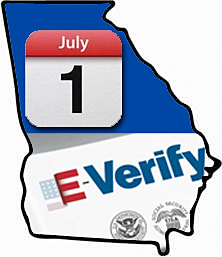
Reminder: Phase 2 of E-Verify compliance requirements for GA companies takes effect July 1st.

[Editor’s Note: today’s post is brought to you by guest blogger Katie Nokes Minervino, Associate Attorney in the Immigration Group at Pierce Atwood LLP.]

As discussed in our prior post about the Georgia E-Verify laws, the E-Verify requirements under the Georgia immigration law are staggered according to company size. On July 1st, Georgia employers with less than 500 but more than 100 employees must start using E-Verify.

Businesses with less than 99 but more than 11 workers have an additional year to comply with the E-Verify requirements (they must start by July 1, 2013). Businesses with 10 or less employees are exempt. The largest Georgia companies with 500 or more employees were required to begin their E-Verify use and compliance on January 1, 2012.

Disclaimer: The content of this post does not constitute direct legal advice and is designed for informational purposes only. Information provided through this website should never replace the need for involving informed counsel on your employment and immigration issues.

Discover how Tracker’s electronic I-9 software service lets you produce flawless I-9s every time. Feel free to contact us we’d love to hear from you.

DREAMers: Potential Problems in I-9 Compliance

[Editor’s Note: today’s post is brought to you by guest blogger Bruce Buchanan, an immigration attorney in the Nashville, TN office of Siskind Susser PC.]


As we finish applauding or booing (whichever you feel like) President Obama’s decision to grant deferred action to DREAMers, we need to think about potential I-9 compliance issues which may arise with so many individuals receiving work authorization documents or cards (EADs).

One potential issue is where a current employee receives an EAD but previously he provided fraudulent documentation, such as a fraudulent permanent resident card, EAD, or Social Security card, to you, the employer. That employee then presents a new and valid EAD to the HR manager and confides the prior documentation was fraudulent. What should an employer do in this situation? Much depends on your company’s policy on presenting fraudulent documents or lying on a company or government document.

There are several options. The first is to accept the new EAD, have a new I-9 form filled out and attach the old I-9 form to the new one with an explanation of the circumstances of completing the new I-9 form. If your company has a policy or practice of copying the underlying documentation, or is required to under state law, the new EAD should be copied. This option should only be utilized if your company does not have a policy or practice of automatic termination for presenting fraudulent documents or lying on a company or government document.

A second option is to inform the employee that your company has a policy prohibiting employment of employees who have presented fraudulent documents or lied on a company document. Thus, the employee is going to be terminated. However, if the company does not have a policy prohibiting their re-hire, the company may offer to re-hire the employee and fill out a new I-9 form with an explanation of the circumstances.

The third option is to inform the employee that your company has a policy prohibiting employment of employees who have presented fraudulent documents or lied on a company or government document and that employee is not eligible for rehire. Thus, the employee must be terminated without a chance of rehire. This action is particularly harsh but may be the only way for an employer to go if it wants to remain consistent with its policy.

The option that a company chooses will be dictated by your company’s policy and practice. Don’t have a policy concerning employment of employees who have presented fraudulent documents or lied on a company document? It may be time to start thinking about getting one. Consult with a qualified immigration compliance or employment attorney to develop an I-9 policy that addresses all the current legislation and best practices.

Always be consistent in your practices, especially when it comes to documentation. If you do a good deed by retaining a DREAMer after he has provided a valid EAD and admitted previously providing a fraudulent document, then, to be consistent, you may have to retain an employee who lied on his application about a felony conviction. Again, consistency is important.

Disclaimer: The content of this post does not constitute direct legal advice and is designed for informational purposes only. Information provided through this website should never replace the need for involving informed counsel on your employment and immigration issues.

Discover how Tracker’s electronic I-9 software service lets you produce flawless I-9s every time. Feel free to contact us we’d love to hear from you.

Company forfeits $2 million for hiring undocumented workers

[Editor’s Note: today’s post is brought to you by guest blogger Bruce Buchanan, an immigration attorney in the Nashville, TN office of Siskind Susser PC.]


In a continuing trend of higher fines and forfeitures, the U.S. Attorney’s Office and U.S. Immigration and Customs Enforcement’s (ICE) Homeland Security Investigations (HSI) announced ABC Professional Tree Services Inc. (ABC) had agreed to pay $2 million as forfeited funds to the Department of Homeland Security and adhere to revised immigration compliance procedures in return for the government agreeing not to criminally prosecute the company.

ABC is a Houston-based company that provides right of way vegetation management for electric utilities in more than a dozen states. ICE-HSI agents, in Birmingham, Alabama, began investigating ABC in early 2008 following complaints that a significant portion of the company’s employees were undocumented aliens. In March 2008, agents conducted traffic stops on ABC crews and detained employees, who were determined to be unlawfully present in the United States.

In June 2008, ICE-HSI agents reviewed the I-9 forms and supporting documentation for about 2,500 employees at ABC. The inspection revealed a significant number of employees had presented invalid personal identification documents, such as permanent resident cards, work authorization cards, and driver licenses, at the time of hire. As of the second quarter of 2009, about 30 % of the workforce was determined by ICE to be undocumented workers.

On March 4, 2010, ICE-HSI agents executed a search warrant at ABC’s Houston headquarters seizing employment and personnel records. Additionally, agents detained undocumented workers, who were on site at the headquarters. More undocumented ABC employees were detained during a traffic stop in Birmingham on that same day.

The government’s investigation revealed ABC had ignored federal law for years, by falsely attesting on I-9s that work authorization documents presented by new hires appeared genuine. In addition, for several years, ABC had received “no-match letters” from the Social Security Administration (SSA) and similar information from the company’s payroll processor, both of which indicated employee names and Social Security numbers did not match SSA records. However, the company failed to take corrective measures, resulting in the continued employment of the undocumented aliens.

ABC derived at least $2 million in revenue from the provision of services to electrical utilities with its undocumented workforce from 2006 through 2011. This figure represents the amount of money that ABC agreed to forfeit to the government.

Since September 2008, ABC has used E-Verify to verify the employment eligibility of new hires. Beginning in the fall of 2008, the company also revised its immigration compliance procedures to include new policies concerning the proper completion, retention and auditing of I-9s and for responding to SSA no-match letters. Furthermore, ABC has terminated hundreds of undocumented workers.

Just in 2012, ICE-HSI has fined or agreed to forfeitures at the following companies or business executives in these amounts (only listing those of $100,000 or more): Atrium Companies – $2 million; Advanced Containment Systems Inc. (ACSI) – $2 million; HerbCo – $1 million; Sun Drywall and Stucco, Inc. – $225,000; two executives of LTCI Ltd. – $223,000; and J & J Industrial Supply – $150,000.

Disclaimer: The content of this post does not constitute direct legal advice and is designed for informational purposes only. Information provided through this website should never replace the need for involving informed counsel on your employment and immigration issues.


Discover how Tracker’s electronic I-9 software service lets you produce flawless I-9s every time. Feel free to contact us we’d love to hear from you.

E-Verify: Thinking about taking the plunge?

[Editor’s Note: today’s post is brought to you by guest blogger Katie Nokes Minervino, Associate Attorney in the Immigration Group at Pierce Atwood LLP. Katie assists employers and employees in employment authorization needs and provides clients with support and guidance on employment verification requirements, best practices, and audit response.]

E-Verify and I-9 News BlogE-Verify is the federal government’s current foray into electronic verification of employment authorization of US workers that functions as a complement to— not a replacement for — the traditional paper-based Form I-9 employment verification system. Over the past few years, many employers have found themselves in a “sink or swim” situation as they have been forced into this otherwise optional program by laws mandating their use. Others have voluntarily enrolled in the program. The remaining majority are now finding themselves teetering at the edge wondering whether or not to take the plunge.

E-Verify: Who Should Jump Right In

Businesses required by law should enroll in E-Verify and structure their participation to comply with applicable laws and the terms of the program. Currently many employers are required by state or local law to enroll in E-Verify, and all signs indicate that this trend will continue. Certain federal contractors are also required to use E-Verify. Further, multi-state corporations may consider enrolling nationally to avoid facing the moving target of state-by-state compliance and the associated burden as new state laws are passed. Employers who have previously been the subject of an I-9 audit and related fines should also strongly consider enrolling in the program.

E-Verify: Who Should Stay on Shore

E-Verify use has its drawbacks. These include employer-borne costs of training personnel and allocating resources to correctly administer the program, the addition of an extra step in the hiring process, and the risk of a “false positive” for a new hire that may raise an unnecessary red flag that requires corrective action. For companies with limited HR resources or who would face significant burdens in regularly accessing the online program not required or otherwise inclined to enroll, the costs will not likely justify the benefits. Some employers simply do not want to participate in the “voluntary” program, and can elect this approach unless otherwise required to enroll.

E-Verify: Who Should Test the Waters

As the program is currently structured, employers have options in how they use E-Verify, including limiting use for new hires at only one (or a handful) of hiring sites. Enrolling in the program for use at a single hiring location, for example, does not trigger a nation-wide E-Verify use requirement for all hiring sites of a given company. While E-Verify is imperfect, the federal government has put significant resources into the program and more and more states are imposing E-Verify requirements. Odds are good that most employers will need to at least consider participation at some point in the future.

Enrolling in E-Verify on a limited basis is a good option for employers with the necessary resources to properly administer the program who may otherwise be on the fence. Choosing to participate at one hiring site provides an opportunity to gain familiarity with the program and complete the necessary training and registration on the employer’s own timeline. E-Verify experience may also provide a competitive edge when competing for business. Companies are increasingly adding employment verification compliance provisions to service contracts, which may include current (or perhaps future) E-Verify use. Putting “a toe in the water” provides companies negotiating such contracts an advantage over companies that are not familiar with or currently contemplating at least limited use of the program.

No matter their current E-Verify enrollment status, all US employers should continue to monitor E-Verify related developments to acquire a general understanding of program requirements and any pertinent compliance deadlines.

Disclaimer: The content of this website is for information purposes only and should not be construed as legal advice or a legal opinion on any specific facts or circumstances, nor does it create attorney-client privilege. This blog should never replace the need for involving informed counsel on your employment and immigration issues.

Discover how Tracker’s electronic I-9 software service lets you produce flawless I-9s every time. Feel free to contact us we’d love to hear from you.