Introducing our latest Tracker I-9 video, explaining the Five Best Practices to Follow When Completing the Form I-9 and E-Verify for Under-Age 18 or Disabled Employees.
Click this link to watch the video:
Introducing our latest Tracker I-9 video, explaining the Five Best Practices to Follow When Completing the Form I-9 and E-Verify for Under-Age 18 or Disabled Employees.
Click this link to watch the video:
 A free E-Verify Self-Check feature that allows individuals over the age of 16 to confirm the accuracy of their U.S. employment eligibility will go live on March 21, 2011 in selected states. The E-Verify Self-Check (Self-Check) phase one roll-out will be available to individuals who currently maintain residency in Arizona, Colorado, Idaho, Mississippi and Virginia, or the District of Columbia. As initial testing and system improvements are made, it is expected that USCIS will expand Self-Check to other states, and eventually be available nationwide.
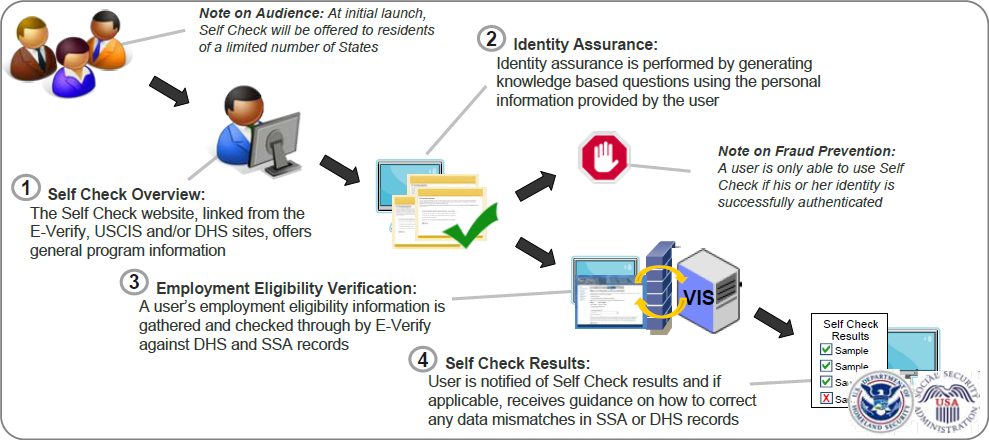
If the new feature works as expected, individuals will be able to use Self-Check in much the same way as employers use E-Verify, except that individuals will need to take extra steps to verify their own identity. After entering certain biographical information, an independent third party service is used to complete the identity verification process, and if successful, the user is redirected to Self Check to enter additional information in order to complete the employment eligibility check. Self Check will then return one of three results: Work Authorization Confirmed, Possible Mismatch with SSA, or Possible Mismatch with Immigration Information.
If any mismatches are found between the information provided to Self-Check and the governments records, the system will provide instructions on how resolve the issue. Below is a diagram of Self-Check workflow process (click on the image to enlarge).
Employers are warned not to use Self-Check to pre-screen the employment eligibility of new hires. If an employer or potential employer asks to see a Self-Check query to prove work authorization, individuals are instructed to notify the Department of Justice, Office of Special Counsel for Immigration-Related Unfair Employment Practices at 800-255-7688. Also, a positive Self-Check result does not guarantee that individuals will pass through E-Verify without issue at a later date.
If you are interested in learning more about the Self-Check process, USCIS has posted an E-Verify Self-Check Interactive Preview on its website.
 The enforcement arm of the Department of Homeland Security, aptly named the U.S. Immigration and Customs Enforcement (“ICE”), recently publicized that they will issue a new batch of I-9 inspection notices to as many as 1,000 businesses located throughout the United States.
So, why is this important?
As initially reported by the Wall Street Journal, this announcement is yet another example of what people are calling the Obama administration’s “quiet immigration raid” policy. Instead of the high-profile immigration raids of years past, ICE has been focusing less on rounding up illegal workers and more on targeting unscrupulous employers through the use of Form I-9 audits and investigations of their hiring practices. Last month ICE announced the establishment of a new employment compliance inspection center and it appears they plan on putting these new resources to work. You can read the full WSJ article here.
As we previously reported, ICE released a worksite enforcement memo which details the most common reasons why a company might receive an audit, as well as who can be targeted. Frequently, ICE investigates companies based upon an employee or public whistleblower complaint.
Although ICE declined to name specific companies to be included in this rounds of audits, according to their statement, “The inspections will touch on employers of all sizes and in every state in the nation – no one industry is being targeted nor is any one industry immune from scrutiny.”
So how can you best prepare for a potential ICE audit?
First, companies should consider conducting a preemptive internal audit to get your I-9 house in order. Then analyze your results, initiate targeted training, and standardize your I-9 practices and procedures.
As you will probably find out, the paper Form I-9 process is error-prone and hard to centralize. Therefore, after conducting the internal audit you will want to implement a trustworthy electronic management system to keep track of all the I-9 documents, deadlines, and work visa reverification requirements.
These steps are especially important for companies that have a large number of employees, high turnover rates, and/or multiple worksites. Of course, employers should always consider the need for involving informed counsel on your employment and immigration issues.
Disclaimer: The content of this post does not constitute direct legal advice and is designed for informational purposes only. Information provided through this website should not act upon it without consulting legal counsel as individual situations and facts may vary.
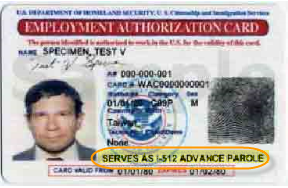 As we reported on Friday, the United States Citizenship and Immigration Services (USCIS) is now issuing employment and travel authorization on a single card for certain foreign nationals. Employers may accept this card as a List A document when completing the Employment Eligibility Verification, Form I-9.
As advertised, the new dual-purpose card looks nearly identical to the current Employment Authorization Document (EAD), except for a caption that reads “Serves as I-512 Advance Parole” as noted in the sample image on the left that we just obtained from the USCIS Questions and Answers sheet recently posted on their website here.
Today, USCIS announced that it is now issuing a new document that represents both employment and travel authorization for certain foreign nationals who have filed an Application to Register Permanent Residence or Adjust Status, commonly referred to as a “Green Card Application.” Previously, USCIS issued employment and travel authorization documents separately, and may continue to do so under certain circumstances as necessary. According to the announcement, employers may accept the new work and travel authorization card as a List A document when completing Section 2 of the Form I-9.

Unfortunately, the announcement did not include a sample image of the new card, although apparently it will look similar to the current Employment Authorization Document (EAD or Form I-766) and will include a caption that reads “Serves as I-512 Advance Parole” (click here to see a sample image of an EAD card). We will post an image of the new card as soon as it becomes available since Employers will want to become familiar with it for I-9 purposes.
There’s no doubt that this announcement raises important questions that remain unanswered. Specifically, in the context of the Form I-9 and E-Verify:
We look forward to receiving the answers to these questions as well as additional guidance from USCIS that helps employers understand how the new work and travel authorization card impacts the complex Form I-9 and E-Verify process.
You can read the full USCIS announcement on their website, here.