 Editor’s Note: Today’s post is brought to you by guest bloggers Susan McConn, Avalyn Langermeier and Kari Konikowski, of FosterQuan, LLC. All three authors are well known experts in the field of Immigration Law and I-9/E-Verify compliance.
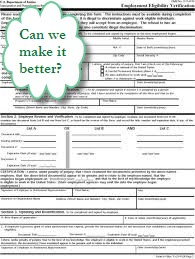
The United States Citizenship and Immigration Services (USCIS) recently issued new guidance for employers on the Form I-9 process. The Handbook for Employers (Rev. 01/05/2011), also known as the Form M-274, has been updated and revised to provide guidance to employers on how to complete the Form I-9, Employment Eligibility Verification. The Form I-9 must be completed for every worker hired after November 6, 1986, regardless of whether the employee is a U.S. citizen or not. The following is a summary of the changes found in the revised Handbook:
Employees with Temporary Protected Status (TPS), Pages 10 – 11
TPS is a temporary immigration benefit that allows foreign nationals from designated countries to reside and work in the United States for a temporary period of time. The Department of Homeland Security may extend a country’s TPS designation and issue a Federal Register notice to automatically extend expiring Employment Authorization Documents for TPS beneficiaries. Thus, a TPS beneficiary may choose to present an Employment Authorization Document that is expired on its face so long as it has been automatically extended. The challenge to employers is how to determine whether a TPS beneficiary’s expired Employment Authorization Document is valid as a List A document.
The Handbook now provides guidance on how to identify a TPS Employment Authorization Document, how to determine whether the Department of Homeland Security has issued an automatic extension of expiring Employment Authorization Documents, and how to explain that the TPS status was extended on the Form I-9.
J-1 Exchange Visitors & F-1 Students, including F-1s Changing to H-1B Status (“The Cap Gap”), Pages 11- 16
The Handbook provides a detailed explanation on how to complete Form I-9 for those individuals in J-1 exchange visitor status (pages 11-13) and F-1 and M-1 student status (pages 13-15). Additionally, the Handbook explains how to complete the Form I-9 for F-1 students who are changing status to H1-B and are eligible for a “cap-gap” extension of status and employment authorization. The Handbook confirms that the student’s employment authorization will remain valid through September 30 of the calendar year for which the H1-B is filed, so long as the student’s H-1B status will begin on October 1. Additionally, the Handbook advises that an employer must re-verify a student’s Form I-20. The Form I-20 must show that the cap-gap extension was endorsed by the student’s designated school official. Re-verification must be done no later than October 1.
H-1B Employees Changing Employers (Portability), Page 17
The Handbook now states that an employee in valid H-1B status who changes (“ports”) to a new employer can begin to work with the new employer upon filing an H-1B petition with USCIS. The prior 2009 version of the Handbook required the porting H1-B employee to obtain a Form I-797 Receipt Notice from U.S. Citizenship and Immigration Services (USCIS) prior to beginning work with the new employer. This approach created considerable delay because it often takes USCIS weeks to issue the official Form I-797 Receipt Notice.
The current version of the Handbook explains that a porting H-1B employee may begin employment by presenting his or her Form I-94/ I-94A issued for employment with the previous employer, along with his or her foreign passport, as a List A document. The employer should write “AC21” on the Form I-9, record the date that the new H-1B petition was submitted to USCIS in the margin next to Section 2 of the Form I-9, and attach documentation as specified in the Handbook. (If you use electronic I-9 software, make the annotation in the notes section of the I-9 record.)
Extensions of Status, Pages 17 and 18
The Handbook explains that an employee with a petition for extension of status timely filed before the employee’s work authorization expires is eligible for continued work authorization for up to 240-days beyond the expiration date of the authorization as long as the extension remains pending. The Handbook provides a detailed explanation on how to complete the Form I-9 and the documentation to be attached for individuals in E-1, E-2, H-1B, H-2B, H-3, L-1, O-1, O-2, P-1, P-2, P-3, Q-1, R-1 and TN status who have timely filed extensions with the same employer.
Where an H-1B extension is timely filed and the extension remains pending, the employer should write “240-Day Ext.” and record the date the employer submitted the Form I-129 to USCIS in the margin of Form I-9 next to Section 2. (Again, for electronic I-9 systems, makes these types of annotations in the notes section of the I-9 record.)
Additionally, the Handbook expands upon what documentation should be added to the Form I-9. Previously, the employer was advised to attach only the USCIS Form I-797 Receipt Notice. Now, the Handbook adds that the employer should retain the following documents with the Form I-9 in this situation:
- A copy of the new Form I-129 that was filed for the extension,
- Proof of payment for the filing of the new I-129, and
- Evidence that the new Form I-129 was mailed to USCIS.
- After the extension is filed, USCIS will issue a receipt notice (Form I-797(C)), which should also then be added and retained with the Form I-9.
When the extension of stay is approved, the employer should record in Section 3 the document title, number and expiration date listed. The Handbook also adds that the employer must give to the employee the Form I-94A, which is evidence of the employee’s employment authorized nonimmigrant status.
Interruptions in Employment, Page 20
The Handbook now provides guidance to employers that are uncertain about whether a new Form I-9 is required after an employee has experienced a brief interruption in employment. The Handbook provides examples of situations which include “continuing employment,” such as maternity or paternity leave, leaves of absence, transfer from one business unit to another business unit of the same employer, the same employer at another location, etc. An employer is not required to complete a new Form I-9 in these situations so long as there is a reasonable expectation of employment at all times.
Electronic Retention of Forms I-9 and Documentation of Electronic Storage Systems, Page 24
The Handbook offers expanded guidance to employers that use paper, electronic systems, or a combination of paper and electronic systems to retain a Form I-9 (See our previous guest blog post on this important topic here). Employers must follow certain guidelines should they choose to retain Forms I-9 in an electronic generation or storage system, and these guidelines are outlined in the Handbook. One requirement is that an employer must maintain and make available upon request complete descriptions of the electronic generation and storage system and the indexing system that permits the identification and retrieval of documents and records maintained in the system. Employers that are currently using an electronic retention system or contemplating the future use of an electronic retention system should review the information outlined in the Handbook and consult with immigration counsel.
E-Verify and Federal Contractors, Pages 19 and 35
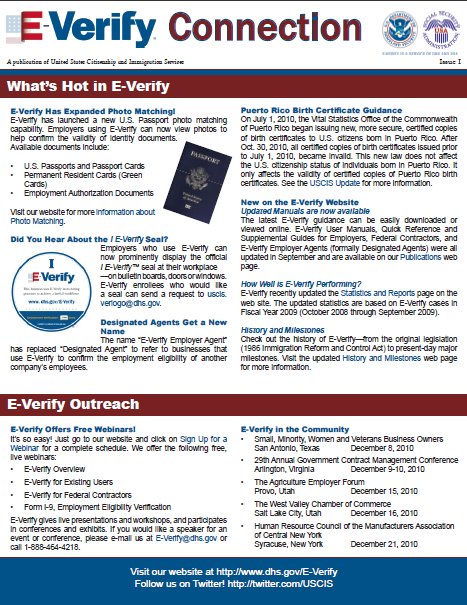
The previous version of the Handbook offered guidance to employers regarding participation in E-Verify and the corresponding Form I-9 responsibilities, such as maintaining a photograph of a List B document. The new version of the Handbook provides additional guidance to Federal contractors about their responsibilities under the amended Federal Acquisition Regulation (FAR) related to employment eligibility verification. The Handbook explains that the regulation requires contractors with a federal contract that contains a FAR E-Verify clause to use E-Verify for their new hires and all employees (existing and new) assigned to the contract. The Handbook also states that where an employee working for a FAR employer undergoes a name change and the employer chooses to verify existing employees by updating existing Forms I-9, then a new Form I-9 must be completed.
Questions and Answers Section, Pages 37 – 49
The Handbook has expanded upon its Questions and Answers (Q&A) section in an effort to provide clarification to employers in a variety of situations related to Forms I-9, including the following helpful information:
- A Native American tribal document is acceptable as both a List B and List C document, and no other documents need be presented. For a current list of tribes recognized by the U.S. federal government, employers may visit the website of the Bureau of Indian Affairs at www.bia.gov. A Certificate of Indian Status does not constitute an acceptable Native American tribal document and may not be accepted for Form I-9 purposes, (pages 38-39);
- An employer may accept a Social Security Card that has not been signed as a valid List C document, (page 39);
- An employee may present an unexpired Form I-94 card notated with work-authorized status in two situations: 1) as a List A document along with his or her foreign passport; or, 2) as a List C document demonstrating work authorization from USCIS, (page 41);
- Employers may accept documents bearing a different name than that which the employee has indicated in Section 1 of the Form I-9, so long as the documents reasonably relate to the employee. The employer may want to attach a brief memo to the Form I-9 detailing the employee’s reason for the name discrepancy, including copies of any supporting documentation the employee chooses (but is not required) to provide, (pages 41-42);
- Significantly more information is provided for employers in the Commonwealth of the Northern Mariana Islands (CNMI), including eight additional Q&As and pictures of sample documents that may be acceptable for Form I-9 purposes in the CNMI only (pages 48-49, 59).
For more information on the updated Employer Handbook or on potential changes to your Form I-9 policies and procedures, please contact your immigration attorney.

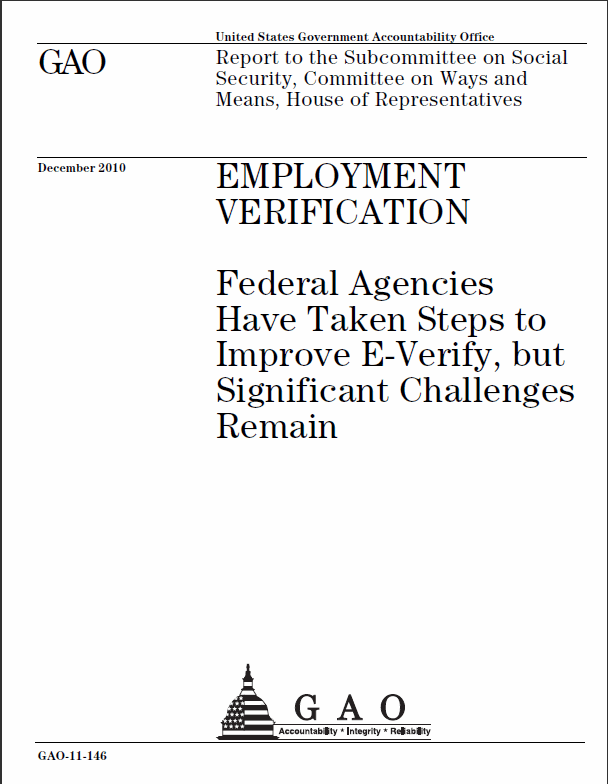 Overall, the GAO reports that E-Verify made significant improvements that reduced the number of erroneous Tentative Nonconfirmations (TNC). However, false-positive TNCs still occur, which can disproportionally affect foreign national employees that may in turn lead to an appearance of discrimination. Furthermore, the E-Verify system continues to be vulnerable to employer fraud and identity theft. The report concludes with a series of recommendations, including several ways to further reduce erroneous TNCs, suggestions for improved education efforts to help employers comply with E-Verify, as well as a call for an honest evaluation by both the SSA and DHS to ensure each agency accurately assess the resources required to fund and operate E-Verify should its use be significantly increased if Congress were to pass an expanded federal mandate.