Pennsylvania House Passes E-Verify Legislation

capdomejpg-44a2513002f80be5Yesterday, the Pennsylvania House of Representatives overwhelmingly passed two proposals (House Bills 1502 and 1503) that would require certain Pennsylvania employers to verify the employment eligibility of construction and contracted public workers via the E-Verify or Social Security Number Verification Services (NVS) systems.

One bill pertains to public works contractors and their subcontractors doing business with the State and would require verification of their workers’ employment eligibility either through E-Verify (for new hires) or NVS (for existing employees). The companion bill carries the same employment verification requirements for private-sector construction companies “whether or not the work is for a public body or paid for from public funds.” Both bills offer protection to employees who report or participate in an investigation relating to an alleged violation.

If the Senate passes the bills (we will keep you posted), employers who violate these rules could face stiff penalties, including the forfeiture of state licenses or certifications and debarment from state projects.

E-Verify Redesign Coming June 13

USCIS has announced that on June 13th it will launch its redesigned E-Verify website which seeks to offer “a clean and modern design, easy and intuitive navigation, and clear and simple language.” As we previously reported, the most significant changes that you can expect to see include a new home page, case alert functionality, verification screen, and case management features. Let’s take a look at some of the new features that E-Verify users will want to know about in order to prepare for these changes.

Home Page

The modifications to the home page are by far an improvement over the existing interface. As shown in the image below, quick links are now offered to start a new case, update existing cases, or view case alerts. The navigation pane on the left-hand side has also been modified, although the overall functionality is the same.
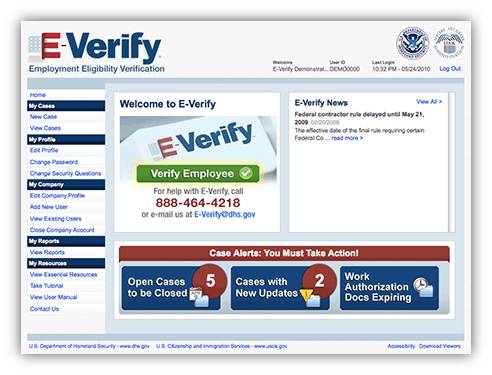
Home_PageAs mentioned in our earlier post, it’s questionable as to how appropriate the E-Verify work authorization expiration reminder is since you may not create a new case in E-Verify to re-verify an employee. Rather, all reverification must be done on the Form I-9.

Creating, Verifying and Closing a Case

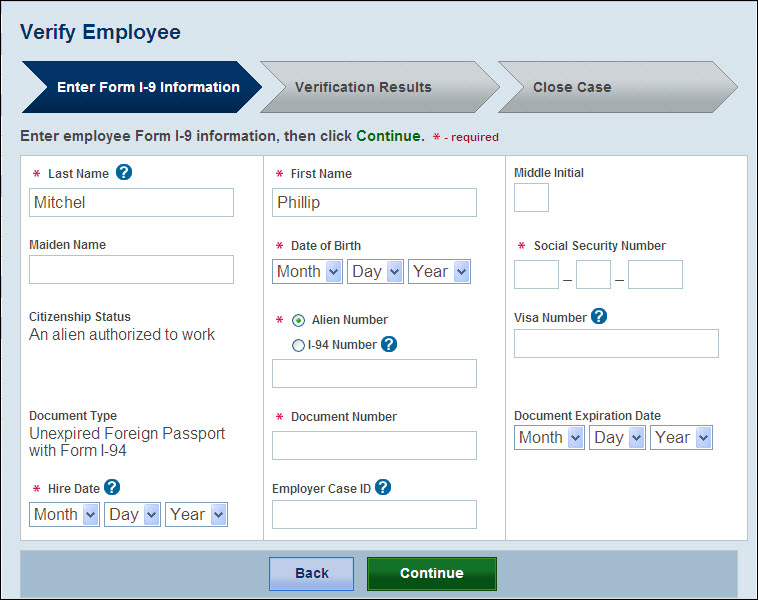
When creating a new case, you will notice the data entry screen where information goes from the employee’s authorization documents now closely resembles the Form I-9 layout. In an effort to reduce the chances of common formatting errors, improvements to the interface have been made such as a segmented Social Security number field and drop-down boxes for all date fields.VerifyEmployee
The status of a case now displays at the top of the screen. Note that you can still access the entire case history by selecting the “View/Print Case Details” link that is located at the top right of the page.

You will also notice that the case status screen now only displays the last four digits of a Social Security number for added privacy and security. The full Social Security number will continue to be included on TNC notices and referral letters since the employee should verify the number for accuracy.Case_Results
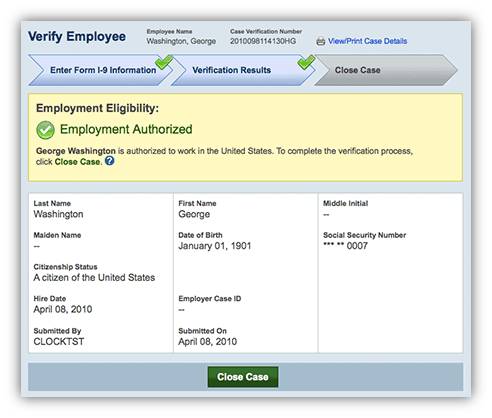
Once E-Verify displays the final results, you are two steps away from closing a case. First, click the green “Close Case” button and then indicate whether or not the employee whose case you are closing still works for the company. Then, E-Verify will offer new closure statement options for you to choose from based upon whether or not the employee continues to work for the company and the disposition of the case.

Memorandum of Understanding (MOU)

Program Administrators for companies enrolled as employers or designated agents can view their signed MOUs by clicking on “Edit Company Profile” in the left menu. Then click the green “View MOU” button at the bottom of the page. MOU signature pages that were submitted by fax are not available for download.

Simplified Terms

Finally, USCIS has simplified some of the language used across the E-Verify system. This is a welcomed change.  As noted in the chart below, USCIS is going for more intuitive and simple terms.

Old Term New Term
Initiate (or run) a query Create a case
Photo tool Photo matching
Request additional verification Request name review
Exit Log out
Resolve case Close case
a
a

NOTE: USCIS has cautioned that they could not update everything all at once. Old terms may linger on some web pages and publications until USCIS allocates the time and resources necessary to update them with their replacements.


USCIS Updates Two Key Work Authorization Documents

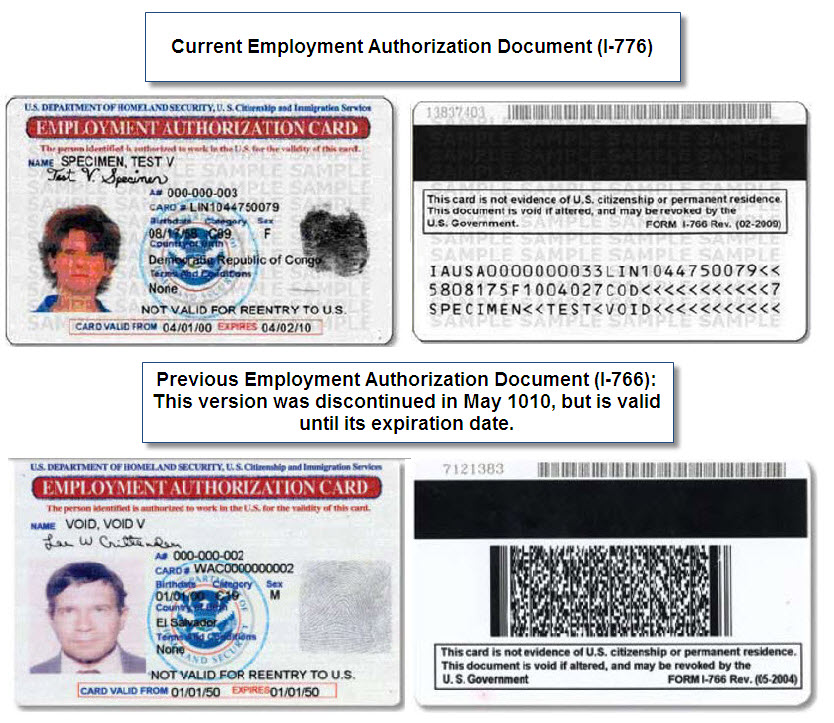
Recently, USCIS announced the release of a redesigned Permanent Resident Card (Form I-551), also commonly referred to as the “Green Card,” as well as a revised Employment Authorization Document (EAD or Form I-766).  While USCIS began issuing the new EAD and Green Cards in May 2010, please note that previously issued EAD and Green Cards already in circulation remain valid until their expiration date.

USCIS has stated that the changes to both documents seek to provide enhanced security features and discourage immigration fraud. As you can see in the sample images below, the backside of the EAD now has a machine-readable zone that replaced the two-dimensional bar code while the front of the EAD card appears to be unchanged. The changes to the Green Card are comprehensive as the document underwent a complete redesign. In addition to the official announcement unveiling the new Green Card and EAD, USCIS has also published a Green Card Fact Sheet that goes into more detail about the changes.

For I-9 purposes, Employers will want to become familiar with the new EAD and Green Card as both are acceptable List A Documents that establish identity and employment authorization.

EAD

PermanentResidentCard blog

USCIS Hosts Employment Eligibility Verification Forum

On Monday May 3, the USCIS hosted a Listening Session to serve as a public venue for providing feedback and input to the USCIS Verification Division, which is responsible for administering both the Form I-9 and the E-Verify program. We participated in the meeting telephonically. In our effort to help you stay informed of the ever changing employment verification landscape, the following is a summary of the more interesting highlights.

The Numbers

  • Over 200,000 employers have registered for E-Verify to date, about half of which were required to do so in order to comply with Federal or State regulations.
  • Nearly 800,000 worksites out of an approximate 7 million in the U.S. have been registered with E-Verify (about 8.75%).
  • On average, about 1,000 new companies enroll with E-Verify per week.

Upcoming Changes to E-Verify

  • The look and feel of E-Verify could be changing soon. USCIS expects to roll out redesigned features for improved ease of use in an effort to help reduce common mistakes. Specific release dates were not confirmed, however, it was mentioned on the call that several upgrades could be expected as early as June.
  • USCIS is continuing to work on ways to expand the image library used by the photo matching tool.
  • USCIS acknowledged that they are working on a new E-Verify feature that will allow for receipt information to be entered into the system.

Self-Check

  • Scheduled for release in December, the proposed E-Verify Self-Check program would permit individuals to pre-screen themselves, allowing them to verify their status before applying for a new job.
  • Employers would presumably be unable to prescreen candidates through Self-Check.
  • USCIS warned that any employer who would require a potential employee to perform a Self Check would be in abuse of the system.

On a final note, USCIS confirmed that the Puerto Rican birth certificate law scheduled to go into effect on July 1st effectively invalidates all previously issued Puerto Rican birth certificates for I-9 purposes as we reported a few weeks ago. USCIS stated that additional guidance on this front is forthcoming.

You can find more information about the USCIS Office of Public Engagement (OPE), its outreach programs, and future Listening Sessions through their website. We realize many of our readers have busy schedules and are unable to participate in OPE public events, which is precisely why we plan to attend and report on future sessions relevant to E-Verify and I-9. Stay tuned!

Disclaimer: The content of this post does not constitute direct legal advice and is designed for informational purposes only. Information provided through this website should never replace the need for involving informed counsel on your employment and immigration issues

E-Verify Releases Updated Federal Contractor FAQs

E-Verify released an updated list of questions and answers addressing Federal contracts that contain a Federal Acquisition Regulation (FAR) clause and the resulting E-Verify requirements. A full version of the document, which also covers a wide range of other topics, is available on the E-Verify web site. This revised FAQ list apparently replaces the one that was mistakenly released and then retracted last month as we reported.

Tracker will continue to monitor the E-Verify website and be sure to provide updates as necessary. While FAQs can serve as a useful source of information, Tracker encourages employers to engage counsel on all employment and immigration issues, especially for matters that involve the complex rules that govern Federal Contracts and E-Verify.

Disclaimer: The content of this post does not constitute direct legal advice and is designed for informational purposes only. Information provided through this website should never replace the need for involving informed counsel.